
The smell of home hits her full force in the face as she leans against the front door to open it. The brackish winter rain, which has harried her in gusts all the way across seafront, has seeped into the cracked paint and swollen the wood. The door drags heavily across the old Victorian tiles, resisting being opened at every inch.
Inside it’s barely warmer than outside. The air is musty, thickly familiar. It catches in her throat.
‘Dad?’
Her voice fades into the darkness of the hallway.
When there’s no answer, no reassuring sounds of movement from the bowels of the house, she calls again:
‘Dad? It’s me, Raye.’
Shoving the door closed by leaning with her back against it, she stops, holding her breath, listening. Feeling the fear, like pressure all around her heart, that this will be the time she finds him dead on the sofa; he will have lain there undisturbed and undiscovered for weeks, corporeal and undeniable evidence of her neglect, her failure to be the right kind of daughter.
‘Dad?’ Raye hears her voice rise an octave above calm and detached.
With the flick of a switch the over-large, fussy, crystal chandelier illuminates the hall. The light is cold, white, and far too bright in the narrow space. Raye is confronted by her reflection in the gilded mirror above the telephone table. She sees anxiety in her eyes, tension in her face; it makes her look stern, grey, ghostly. Too much like Mum she thinks, Mum with Dad’s blue-green dreamer’s eyes. Mum in the black and white wedding photo hanging beside the mirror.
The next photo along, in colour, is Raye’s christening. Then a photo of her in her school uniform, beaming a carefree, missing-tooth, grin. There’s one of a smartly dressed crowd outside the church at her baptism. The final photo in the series is her graduation, the taut expression on her face recording how uncomfortable and unlike herself she felt in the dress Mum had chosen for her. It’s a timeline, a carefully curated exhibition of her early life, and after that there’s nothing but empty wall.
If she hadn’t been an only child maybe someone else would have filled up the spaces. Raye imagines her conception, shortly after their wedding, as a one off; a necessary box to be ticked and not something to be repeated. Her parents’ careers, hobbies, and friends occupied so much of their time there was barely any time for her let alone another child. Dad’s engineering career kept him away from home for weeks at a time. In his absence Mum orbited the church like a faithful satellite, never wanting to break free from the crushing weight of its gravity.
‘Rachel? Is that you? … You want to use the back door in the winter, love.’
Dad’s voice rises up, cracked with age, haunting, like a recording on a nineteenth century record. Raye’s shoulders drop with relief, and she lets out the breath she had been holding. She puts the bag of shopping down momentarily, next to her overnight bag, and hustles out of her coat.
‘I brought food. Have you been eating enough?… Dad, is the heating off? You know the house gets damp…’
At least in the kitchen it’s warm; he’s got the old Calor gas heater going down there. Raye decides she needs to get him a carbon monoxide alarm, that if old age and a lack of self-care don’t get him, then carbon monoxide poisoning surely will. It looks like he’s been sleeping down there as well, there’s a pillow and a duvet bundled up on the sofa, and it now has the greasy unappealing look of having been lived on too much.
When the kitchen had still been a kitchen, in the time before he had retreated into it until it was the only room he occupied, when the pine table, with its thick lacquer, had gleamed in the morning sunshine which had streamed in through the huge windows of the conservatory extension. Raye would sit on one of the pine pews with her feet, in shiny patent leather school shoes, swinging rhythmically back and forth, as she watched the sea sparkling distantly, waiting for mum to serve up Frosties in the plastic bowl Raye had earned by saving up tokens from the cereal boxes, the one with pictures of Tony the Tiger on them.
Raye can’t remember the last time she saw the table gleaming. It’s glimmer is lost now under a thick layer of grime, clutter, and paint spatter. It’s been pushed back into the far corner to make room for Dad’s easel. It dominates the room, shrouded ghoulishly under its sackcloth cover.
Dad looks thin, hunched. Even when standing he’s still got the same bent shape as when he’s sitting on his stool at his easel, brush poised and loaded with paint.
Raye doesn’t dare lift the sackcloth to see at what he’s been working on; he’s private and possessive over his in progress paintings.
Raye can feel the cold through the glass of the conservatory windows as she watches the string lights between the lampposts on the pier dancing and bouncing in the wind; but she’s remembering the summer, thinking of the summer fair. Her first time riding the Waltzers, Dad pressing a shiny fifty pence piece into her hand to pay for the ride despite mum’s protests. The joy of whirling around to the loud music, the string lights blurring, between sea and land, round and around again.
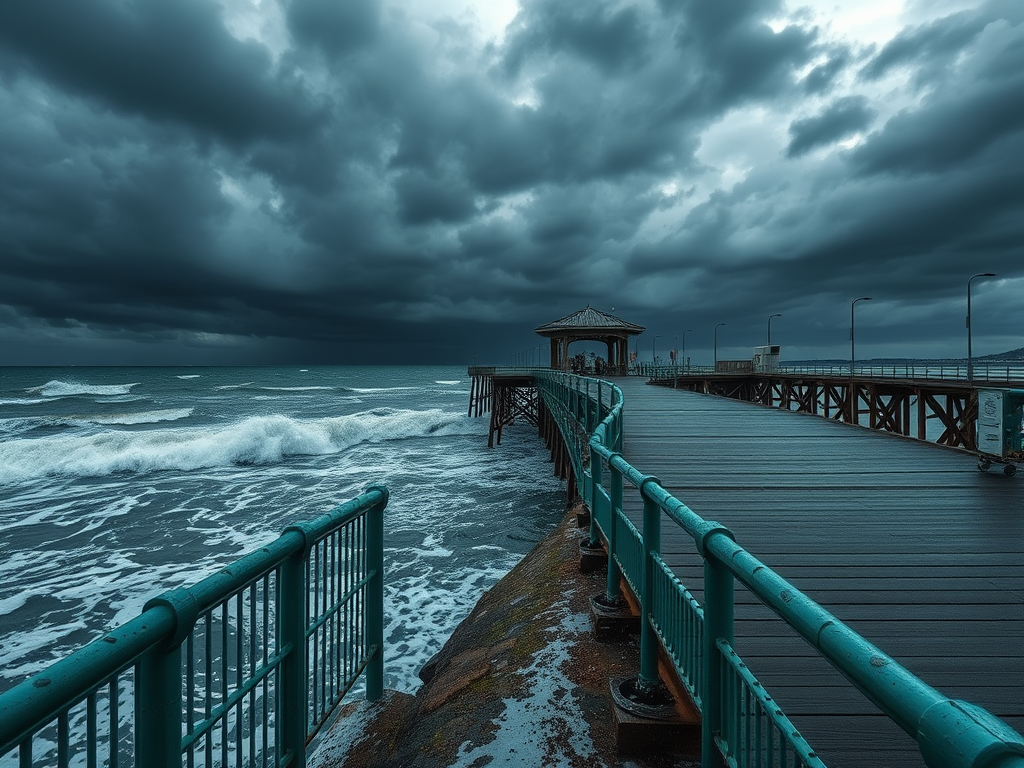
The end of the pier had seemed so far out that evening as she’d skipped along beside her parents, hopping over the gaps in the planks, sliding her hand along the smooth green railing.
As a teenager she’d ridden the Waltzers with Lisa Hardy and had a first cautious kiss halfway out behind the café, closed at night, with her back pressed against the railing, eyes shut tight, hearing the waves crashing below.
She’d held the railing at the end of the pier, the chipped paint splintering painfully into her skin, as she reached over to tip Mum’s ashes into the subdued grey sea.
‘I asked her to marry me here,’ Dad said wistfully. Which was the only thing he’d said to express any kind of feeling about her loss. He never talked about finding her dead in her chair, the stroke forever twisting her immaculately-tended face out of shape. He’d buttoned it up in solitude and silence and gone back to his painting.
‘How’s Mel?… Uh, and the kids?’ Dad asks, as though he’s just remembered them. He’s perched on his painting stool near the corner of the table where he’s cleared just enough space for two bowls of pasta and Raye’s large glass of wine.
‘Um, yeah, they’re good… You know, though, they’re not really kids any more, Layla’s working now and Josie’s in her second year at uni. They’ve both more or less left home.’
Dad nods and chews his pasta thoughtfully. He turns away to look out at the black void of the sea and it absorbs his attention completely, that or he goes back into his internal world, sinking down under the surface leaving only shadowy outlines of himself.
Does he feel any kind of regret? Does any of the guilt and heartache weigh on him like it does on her? Driftwood, Raye thinks, he’s driftwood and Mum was the relentless force ceaselessly rubbing away his hardness and weight, until he’s just floated, gnarled, worn, and lost.
Raye doesn’t feel she’s faired any better, caught in a swirling storm of marriage and children; which started with the stress of IVF, then ended with Raye’s affair and separation when Mel left. Recently reconciled, Raye often finds herself looking at Mel trying to see the woman she fell in love with (sassy, sharp, high-heeled, gorgeous) in the person she wakes to each morning (vague, watery, distant) nothing but the reflection of a face in a rockpool.
There are no pictures of Mel in the house, no pictures of Layla or Josie, except possibly tucked away in a drawer somewhere, most likely still in the envelopes they arrived in. When it had been Raye and Mel’s wedding day it had been too far to travel to Sussex. When Mel had given birth to Layla, it had been an inconvenient time. When Josie had been born Raye notified them and left it at that.
‘But they’re your grandchildren…’ she’d pleaded once, in a moment of weakness.
‘Except they’re not really though, are they, Rachel?’ Mum had replied crisply.
Raye had been able to picture her so clearly in that moment, standing at the telephone table in the hall with the receiver to her ear, checking herself in the mirror to make sure not a hair was out of place, dabbing at her lipstick, then casually picking a fleck of lint off her jumper.
The click of the phone receiver being put back in its cradle had been the click of a door closing firmly shut, never to be reopened. There had been no more talks of visits, and Raye had never brought her family down. They summer-holidayed in France not North Somerset, and Christmases were always spent with Mel’s family.
A few times Mel had said, ‘Maybe if I could just meet them…?’
But Raye insisted it wouldn’t make a difference and the distance had only grown.
Raye pauses by the door to the living room on her way up to bed. A shiver reminds her how cold the house is, there won’t be any hot water to shower. Does Dad even wash or change his clothes anymore?
The living room is thick with dust. Cobwebs adorn the mantlepiece where the fake ivy garlands would usually be hanging at this time of year. There’s a smattering of ashes in the hearth, the remains of a meagre fire. A book lies neatly bookmarked on the table beside Mum’s chair.
All around there are vases of dead flowers. Flowers Raye had dutifully displayed for the stream of people who paraded through the house to offer their condolences and express their incredulity that Raye, the girl they remembered from Sunday School, had become the woman standing suited with equal awkwardness beside her father, shaking their hands and thanking them for coming.
‘Is your husband not here with you?’ one asked, noticing her wedding ring. Raye had only felt able to mutter excuses about work commitments. Mel could never exist there at all.
Thinking about the dead flowers, Dad in the basement, the abandoned house, Raye realises it wasn’t only Mum whose spirit went into the sea that day. Some part of her, some part of Dad, had gone too, into that cloud of ash which had swirled in the air for a moment and then blown out to sea.
Raye gets into bed fully clothed. The pillow is damp under her head. Before she sleeps, she swallows a sleeping tablet, thinking of the risk (having drunk a bottle of wine) that she might not wake up at all. Perhaps it wouldn’t be such a bad thing not to wake up; it’s hard to admit all the things which need attention so often feel like they’re impossible to mend.
Oblivion does not take her and Raye is spat out in the morning, woken suddenly by the sound of the back door slamming.
By time her head clears enough to get up and go down to the kitchen, dad is gone. He’s left a half-full cafetiere on the side and it’s still warm. Gratefully nursing a mug of coffee, Raye goes to the window to look out at the bleak morning, grey sky, dark shadowy sea; hoping dad wrapped up well against the dank air.
Finding an opportunity in his absence, Raye lifts the cloth off the easel to look at the painting. She recognises the scene, Dad had been putting the finishing touches to it after the funeral, a picture of the pier in the summer with the bright lights and colourful fair at its centre.
Except he’s painted over it.
The turquoise blues of the sparkling sea are now stormy and grey, the sky is leaden. The fair is gone, and the happy people have been painted out of existence. The only figure is a solitary bent old man standing by the railing at the end of the pier.
The view Raye sees now outside the window resembles the painting in almost every detail, except, when she squints, with her heart racing, searching for the figure at the end of the pier, he’s gone.

 E. Travelli